Skip to content
Cruz RainesThe Shop-Bay Bookshelf

Repair-counter guidance from Cruz Raines

Know what you authorize before the wrench turns

Bring the symptom, read every line, and separate permission to diagnose from permission to repair. This handbook gives you a practical process for asking what the shop knows, what it suspects, and what happens after you say yes.

Shop-Counter Protocol

PDF

65 pages · 9 chapters · 3 checklists

Don't Get Ripped Off at the Shop

65-page PDF e-book

64Pages
9Chapters
$19Your order

On the shelf

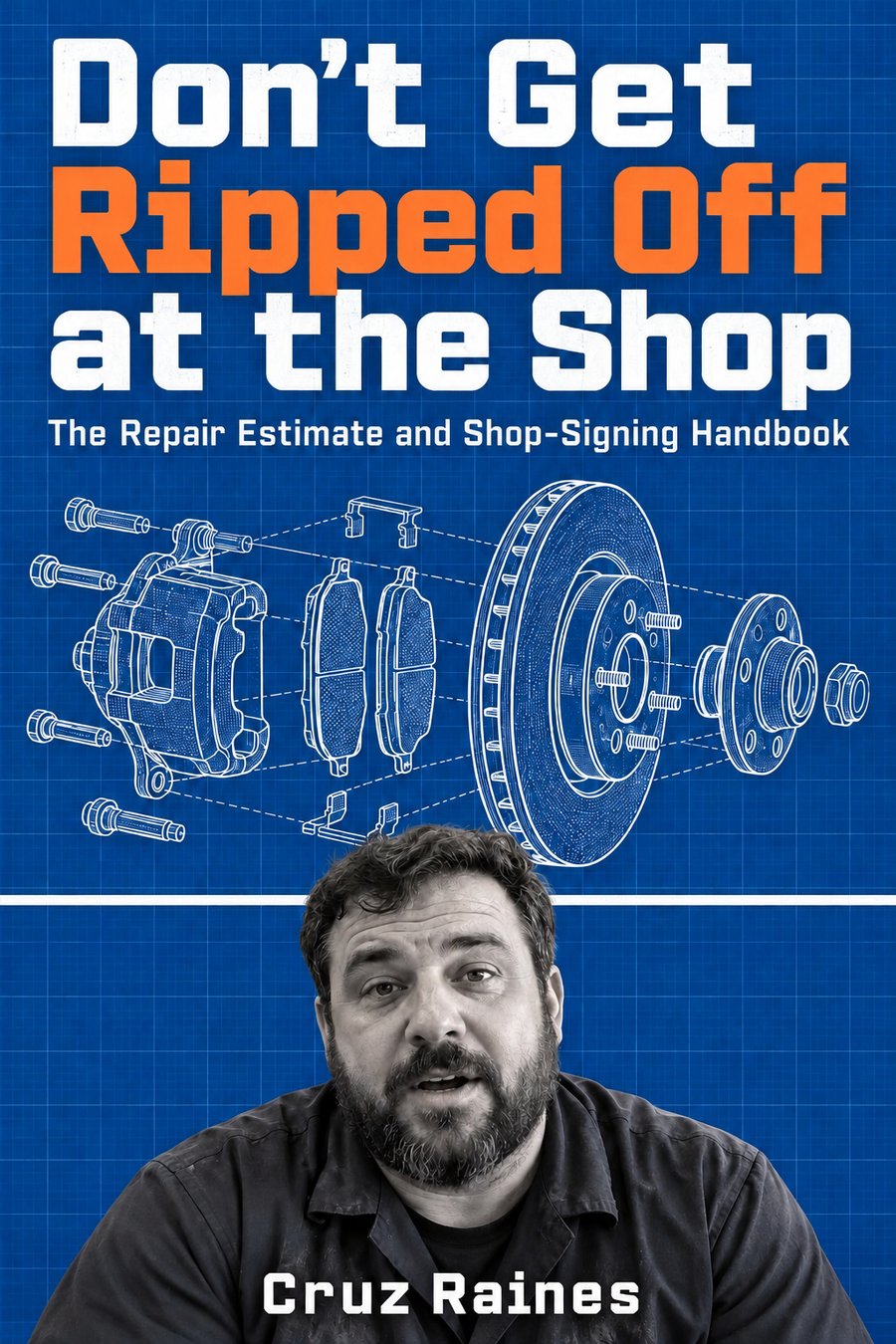
Don't Get Ripped Off at the Shop

Don't Get Ripped Off at the Shop

On the shelf / 01

Don't Get Ripped Off at the Shop

The Repair Estimate and Shop-Signing Handbook

Give the shop one accurate symptom, authorize diagnosis to a written limit, and require another conversation before repair work begins.

Don't Get Ripped Off at the Shop is a 65-page handbook with 9 chapters for drivers facing an estimate, repair authorization, or final invoice. It shows you how to report a symptom without guessing at the failed part, distinguish diagnostic work from replacement labor, and read charges for parts, fees, tax, and shop supplies. You will also learn to rank recommendations, set an approval ceiling, examine warranty terms, recognize patterns of pressure or evasion, and preserve the paper trail at pickup. Three tables and three checklists support the Shop-Counter Protocol: slow down, ask, approve, and verify.

Selected chapters

  1. Before the Estimate Exists
  2. Anatomy of a Repair Estimate
  3. Diagnosis Is Work
  4. Parts, Labor, and the Real Total
  5. Urgent, Soon, or Optional?
  6. What to Ask Before You Sign
  7. The Warranty Is Part of the Repair
  8. Red Flags Without Paranoia
  9. Pickup, Verification, and the Paper Trail

The Shop-Bay Bookshelf

The signature line comes before the explanation

A repair conversation moves quickly when your vehicle is already on a lift. These are the moments when a written process helps.

  • The estimate lists diagnosis, parts, labor, fees, and tax, but nobody has explained which line authorizes testing and which line authorizes replacement.
  • A fault code is presented as the answer, yet you have not heard what was tested or what evidence points to the proposed part.
  • Several recommendations arrive at once, and you need to separate an immediate safety concern from work that can reasonably wait.
  • The total changes after drop-off, but the approval limit and next-call requirement were never written down.
  • You are picking up the vehicle and need to compare the final invoice with the work you actually authorized.

Selected chapters

Three places to enter the repair conversation

Read from the beginning for the full Shop-Counter Protocol, or open the handbook at the decision directly in front of you.

  1. Before the Estimate Exists

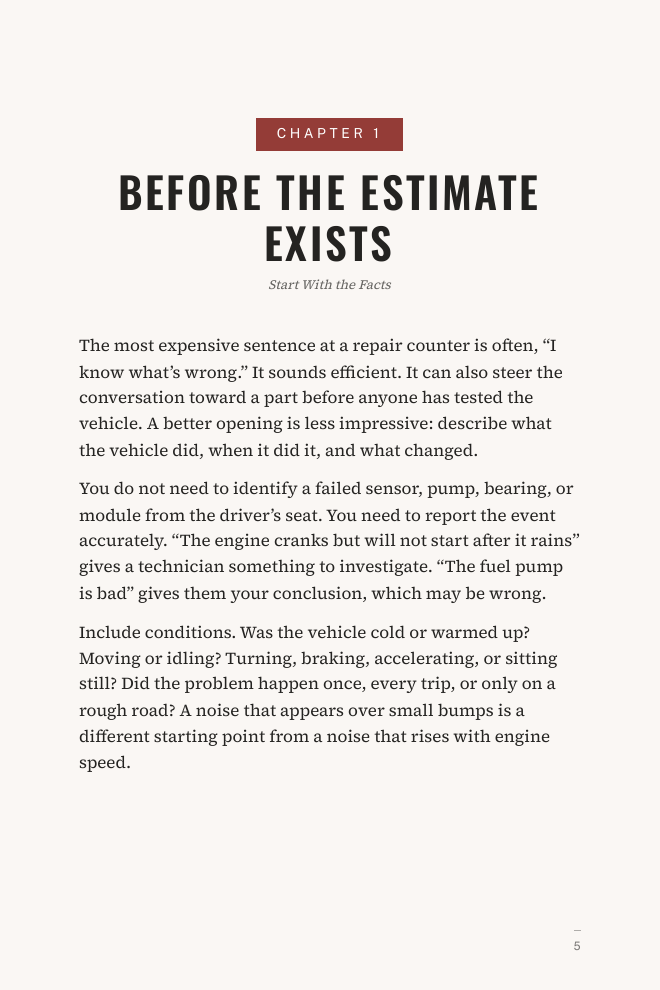
    Write what the vehicle did, when it happened, and what changed beforehand. Bring the mileage, warning messages, recent invoices, and a clear diagnostic spending limit.

  2. What to Ask Before You Sign

    Ask what evidence supports the recommendation, what alternatives exist, what the complete authorized total covers, and when the shop must call before doing more.

  3. Pickup, Verification, and the Paper Trail

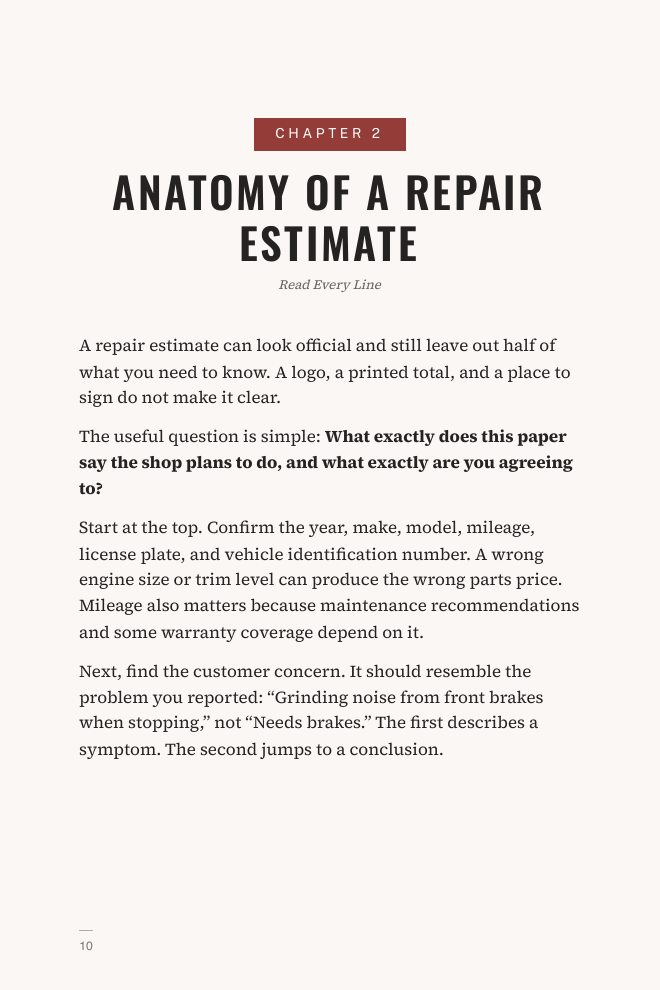
    Set the authorization beside the final invoice. Check the named work, preserve the warranty records, and document the next conversation if the original symptom remains.

Look inside

Inspect the pages, not just the promise

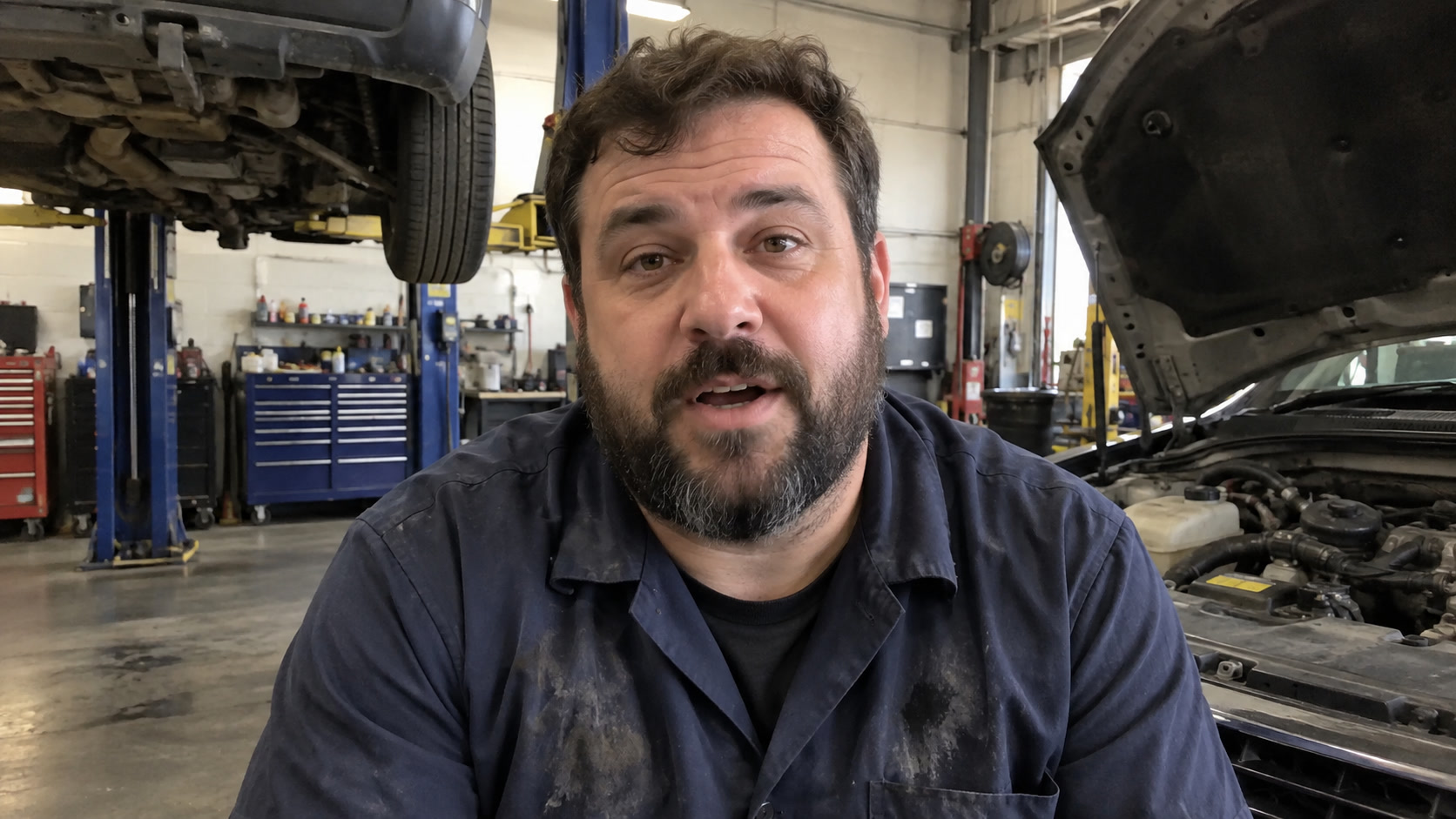
The portrait and reader illustrations place the material where it belongs—in the bay, at the counter, and beside the paperwork.

65 pages · 9 chapters · 3 checklists

Page 6 — Before the Estimate Exists
Page 6 — Before the Estimate Exists ↗
Page 11 — Anatomy of a Repair Estimate
Page 11 — Anatomy of a Repair Estimate ↗
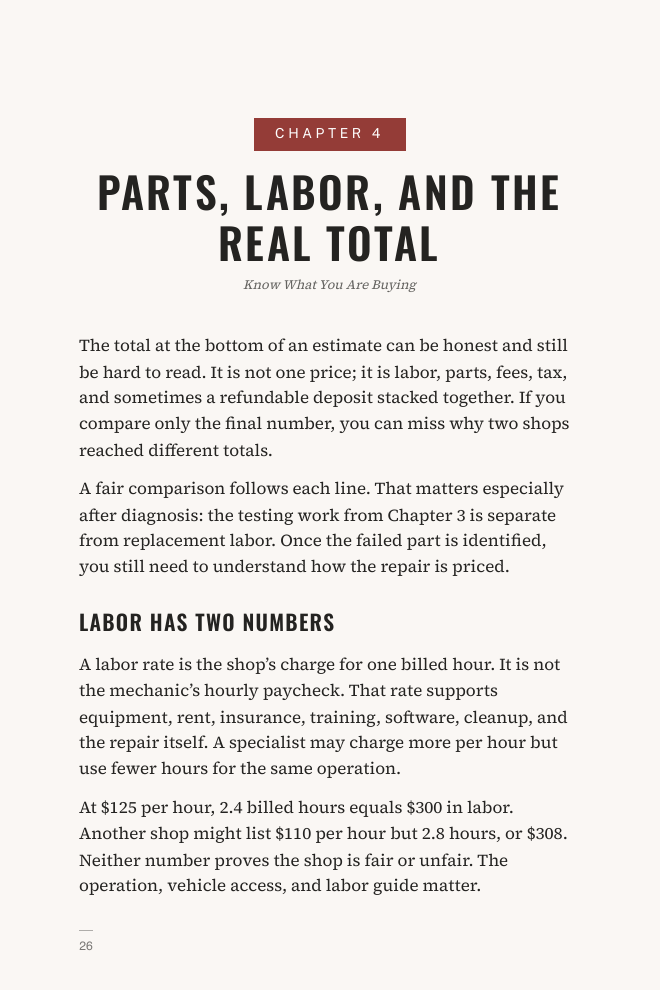
Page 27 — Parts, Labor, and the Real Total
Page 27 — Parts, Labor, and the Real Total ↗
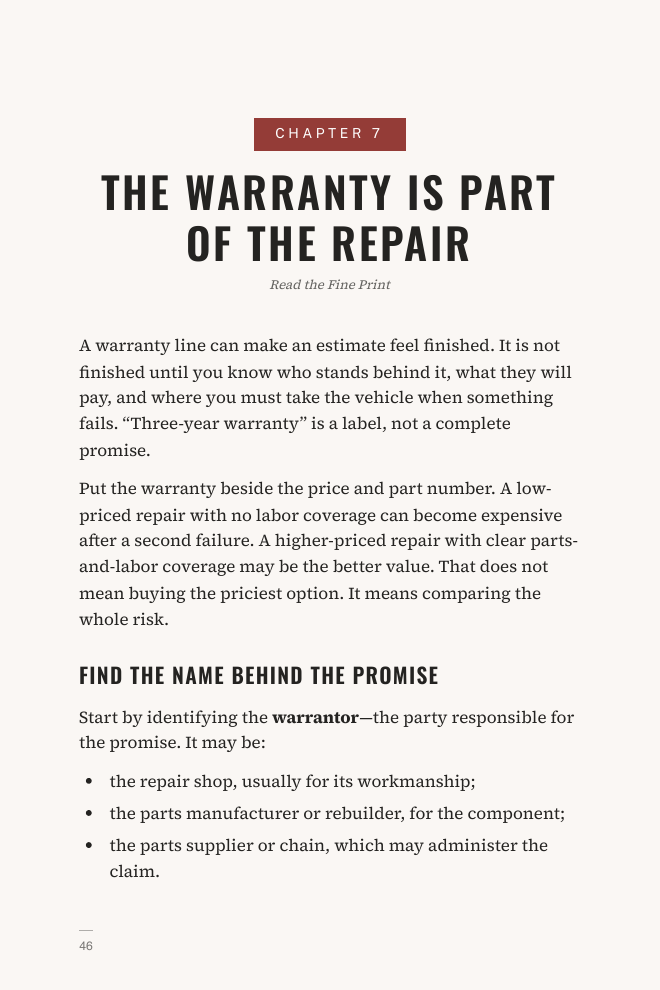
Page 47 — The Warranty Is Part of the Repair
Page 47 — The Warranty Is Part of the Repair ↗
Cruz Raines

From the repair bay

I wrote this from the service-bay side of the counter

I have spent two decades diagnosing engines, fixing brakes, and learning from mechanics with more years behind a wrench than I had.

I wrote this book because customers often have to make decisions while staring at unfamiliar parts, labor lines, and signature boxes. I sometimes diagnose CVTs, but I refer calibration-dependent repairs to dealers. That kind of boundary matters: good work includes saying what is known, what remains uncertain, and who is equipped to handle the next step.

— Cruz Raines

This is for you if

Who I wrote this for

This is for you if

  • You drive a vehicle but do not work in the trade, and you want plain language for discussing estimates without pretending to be the technician.
  • You have an estimate in hand and need a repeatable way to examine diagnosis, parts, labor, fees, authorization, and warranty coverage.
  • You want to ask direct questions without treating every mechanic as dishonest or turning the service-counter conversation into a fight.
  • You prefer a compact reference with 3 tables, 3 checklists, and 7 glossary terms that you can consult during a real repair decision.

What you get

One handbook for the full shop-counter sequence

Your order includes Don't Get Ripped Off at the Shop as a PDF e-book. The book contains 65 pages, 9 chapters, the Shop-Counter Protocol, 3 tables, 3 checklists, and 7 glossary terms covering the path from first symptom to final invoice.

Don't Get Ripped Off at the Shop

Your order

Don't Get Ripped Off at the Shop

$19

65-page PDF e-book

7-day money-back guarantee

65 pages · 9 chapters · 3 checklists

  • Don't Get Ripped Off at the Shop · 65 pages · PDF
Get the handbook $19

PDF

The Shop-Bay Bookshelf

What you can do at the counter

AI-generated illustrations of potential readers.

Describe the problem without diagnosing it

Turn noises, warning messages, driving conditions, and recent changes into a useful customer concern instead of arriving with an untested parts conclusion.

AI-generated illustrations of potential readers.

Compare estimates line by line

Identify labor, parts categories, markup, core charges, shop supplies, environmental fees, taxes, warranties, and the amount you are actually authorizing.

AI-generated illustrations of potential readers.

Decide what happens next

Sort work into urgent, soon, or optional; ask what delay could change; set an approval ceiling; and verify the invoice before leaving with the vehicle.

AI-generated illustrations of potential readers.

The Shop-Bay Bookshelf

Questions from the counter

How is the book organized?

Nine chapters follow a repair from first symptom to final invoice: preparing before the estimate, reading it line by line, separating diagnosis from repair, ranking recommendations, asking before you sign, warranties, red flags, and checking the paperwork at pickup.

Do I need mechanical experience to use this book?

No. The book starts with what you can observe from the driver's seat: when the symptom occurs, what the vehicle does, which warning message appears, and what changed recently. It then gives you plain questions for the parts of the estimate you do not understand.

Will this tell me whether a shop's diagnosis is correct?

The handbook teaches you to ask what testing was performed, what evidence supports the recommendation, what remains uncertain, and whether specialist or dealer equipment is needed. It does not ask you to replace a technician's testing with a guess from the counter.

Does the book explain diagnostic charges?

Yes. Diagnosis Is Work separates testing time from replacement labor and explains why a fault code is a starting point rather than a complete verdict. It also shows how to ask what the initial diagnostic charge includes and when the shop must call before continuing.

Can it help me decide which recommended repairs can wait?

Urgent, Soon, or Optional? provides a structure for separating immediate safety concerns, damage-prevention work, reliability concerns, scheduled maintenance, and optional work. It also supplies questions about what may happen if a repair is delayed and how long the recommendation can reasonably wait.

Why pay for the book when repair videos are free?

A video may explain one symptom, part, or estimate example. This handbook puts the complete conversation in order, from describing the concern and authorizing diagnosis to reviewing warranties and checking the final invoice. Its 3 tables and 3 checklists are built to be consulted while you prepare, approve, and verify.

What file format do I receive?

Don't Get Ripped Off at the Shop is available as a PDF e-book. The book contains 65 pages.

Does it explain warranties and customer-supplied parts?

Yes. The warranty chapter covers who backs the warranty, whether parts and labor are included, where return work must be performed, which records to keep, and what to ask before accepting customer-supplied or remanufactured parts.

Is the book written to make me suspicious of every repair shop?

No. Red Flags Without Paranoia distinguishes ordinary business practices and honest uncertainty from patterns such as pressure, evasion, contradictions, or unauthorized work. The aim is to document facts, ask for clarification, and pause when the explanation does not match the paperwork.

What if the book is not for me?

Every order is covered by a 7-day money-back guarantee. Reply to the purchase email you got from Hotmart and ask for your money back.
Make the first yes mean what you intended

Open the estimate, identify what is known, and separate diagnosis from repair. Then sign only after the work, limit, and next approval point are clear.

Get the handbook $19

PDF